What are the thermal conductivity properties of glycol ethers?
Glycol ethers are a class of solvents with a wide range of applications, including coatings, inks, and cleaners. Understanding their thermal conductivity properties is crucial for many industrial processes, as it affects heat transfer efficiency, energy consumption, and the overall performance of the systems in which they are used. As a leading supplier of glycol ethers, we are committed to providing in - depth knowledge about these important substances.
1. Basics of thermal conductivity
Thermal conductivity (k) is a physical property that measures a material's ability to conduct heat. It is defined as the amount of heat (Q) that flows through a unit area (A) of a material in a unit time (t) due to a unit temperature gradient ($\Delta T$/$\Delta x$) across the material. Mathematically, it is expressed by Fourier's law of heat conduction: $Q = - kA\frac{\Delta T}{\Delta x}$. A high thermal conductivity means that the material can transfer heat more efficiently, while a low thermal conductivity indicates that it is a better insulator.
2. Factors affecting the thermal conductivity of glycol ethers
-
Molecular structure: The molecular structure of glycol ethers plays a significant role in determining their thermal conductivity. Glycol ethers have a general structure of R - O - CH₂CH₂ - OH, where R is an alkyl group. The length and branching of the alkyl group can influence the intermolecular forces and the mobility of the molecules. Longer and more branched alkyl chains tend to increase the intermolecular distance and reduce the efficiency of heat transfer through molecular collisions, resulting in lower thermal conductivity. For example, glycol ethers with shorter alkyl chains have better mobility and can transfer heat more effectively.
-
Temperature: Like most substances, the thermal conductivity of glycol ethers is temperature - dependent. Generally, as the temperature increases, the thermal conductivity of liquids tends to decrease. This is because at higher temperatures, the molecules have higher kinetic energy and are more randomly distributed. This increased randomness disrupts the ordered transfer of heat energy through molecular vibrations and collisions, leading to a lower thermal conductivity.
-
Concentration and mixture: When glycol ethers are used in mixtures, the thermal conductivity of the mixture can be different from that of the pure components. The presence of other substances can affect the intermolecular interactions and the overall heat - transfer mechanism. For instance, when glycol ethers are mixed with water, the hydrogen - bonding between water and glycol ether molecules can change the heat - transfer characteristics of the system. The concentration of the glycol ether in the mixture is also an important factor. At low concentrations, the properties of the mixture may be dominated by the solvent (usually water), while at high concentrations, the properties of the glycol ether become more prominent.
3. Measuring the thermal conductivity of glycol ethers
- Steady - state methods: One of the most common methods for measuring the thermal conductivity of liquids is the steady - state method. In this method, a temperature difference is maintained across a sample of the glycol ether, and the heat flux through the sample is measured. By knowing the dimensions of the sample and the temperature difference, the thermal conductivity can be calculated using Fourier's law. For example, the guarded hot - plate method is a widely used steady - state technique, where the sample is placed between a heated plate and a cooled plate, and the heat flow through the sample is measured under steady - state conditions.
- Transient methods: Transient methods are also used to measure the thermal conductivity of glycol ethers. These methods involve applying a short - term heat pulse to the sample and measuring the resulting temperature change over time. The thermal conductivity can then be determined from the rate of temperature change and the properties of the sample. The transient hot - wire method is a popular transient technique. In this method, a thin wire is placed in the sample, and an electrical current is passed through the wire to generate a heat pulse. The temperature change of the wire is measured, and the thermal conductivity of the sample is calculated based on the heat transfer equation.
4. Applications related to the thermal conductivity of glycol ethers
- Heat - transfer fluids: Glycol ethers can be used as heat - transfer fluids in various industrial processes, such as in heat exchangers and cooling systems. Their thermal conductivity properties are important for ensuring efficient heat transfer. For example, in a cooling system, a glycol ether - based heat - transfer fluid with a relatively high thermal conductivity can quickly transfer heat from the hot equipment to the cooling medium, preventing overheating and improving the performance of the equipment.
- Coatings and adhesives: In the coatings and adhesives industry, the thermal conductivity of glycol ethers can affect the drying and curing processes. Glycol ethers with appropriate thermal conductivity can help in the efficient dissipation of heat generated during the drying and curing reactions, ensuring a uniform and high - quality coating or adhesive film.
5. Our product offerings and their thermal conductivity characteristics
As a glycol ethers supplier, we offer a range of high - quality products with different thermal conductivity properties to meet the diverse needs of our customers.
- Anhydrous Tert - Butanol CAS 75 - 65 - 0: This product has unique thermal conductivity characteristics due to its molecular structure. The relatively short and branched alkyl group in anhydrous tert - butanol allows for a certain degree of molecular mobility, which contributes to its thermal conductivity. It is suitable for applications where moderate heat transfer is required.
- Low - Odor DBEL Solvent CAS 7580 - 85 - 0: The low - odor DBEL solvent has a specific thermal conductivity that makes it a good choice for applications where heat management is important, such as in certain types of industrial cleaning processes. Its thermal conductivity properties ensure efficient removal of heat generated during the cleaning operation.
- Ethylene Glycol Mono - tert - butyl Ether CAS 7580 - 85 - 0: This glycol ether has a well - defined thermal conductivity, which can be adjusted by controlling the process conditions during its production. It is commonly used in coating formulations, and its thermal conductivity helps in the proper drying and spreading of the coating on the substrate.
- MTBE Solvent Grade CAS 1634 - 04 - 4: The MTBE solvent grade has specific thermal conductivity features that are beneficial in various chemical processes. Its ability to transfer heat effectively makes it suitable for use in reactors and other equipment where heat exchange is crucial for the reaction efficiency.
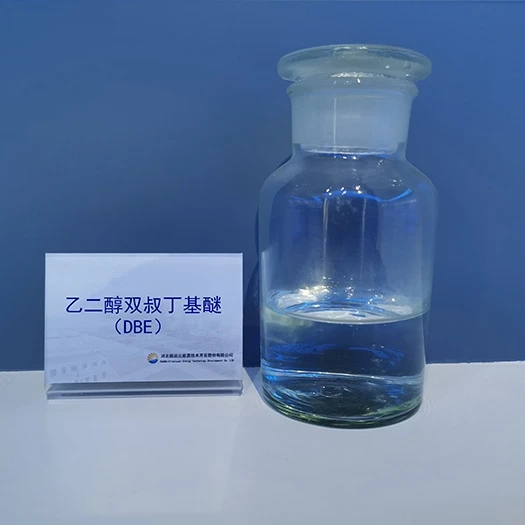
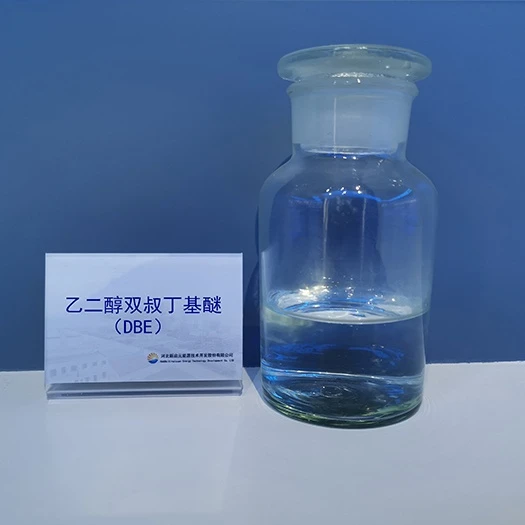
- Ethylene Glycol Di - tert - butyl Ether CAS 26547 - 47 - 7: This product has a distinct thermal conductivity profile, and it is often used in applications where low - temperature heat transfer is required. Its thermal behavior at low temperatures makes it an ideal choice for cryogenic systems and other cold - temperature processes.
We understand that different applications require specific thermal conductivity properties, and our technical team is always ready to assist you in selecting the most suitable glycol ether products. Whether you need a product with high thermal conductivity for efficient heat transfer or one with low thermal conductivity for insulation purposes, we can provide you with the right solution.
If you are interested in our glycol ether products and would like to discuss your specific requirements, we invite you to contact us for a detailed procurement discussion. Our experienced sales team will be happy to answer all your questions and help you find the best products for your needs.
References
- Incropera, F. P., & DeWitt, D. P. (2001). Fundamentals of Heat and Mass Transfer. John Wiley & Sons.
- Poling, B. E., Prausnitz, J. M., & O’Connell, J. P. (2001). The Properties of Gases and Liquids. McGraw - Hill.