Hey there! As a supplier of alkane products, I often get asked about the reaction mechanisms of these products with bases. It's a super interesting topic, and I'm excited to share my knowledge with you.
Let's start with a quick overview. Alkanes are hydrocarbon compounds with only single bonds between carbon atoms. They're known for being relatively stable because of the strong carbon - carbon and carbon - hydrogen bonds. But when it comes to reacting with bases, well, it's not as straightforward as some other compounds.
General Reactivity of Alkanes with Bases
Alkanes are generally considered unreactive towards most bases under normal conditions. This is mainly due to their non - polar nature. Bases usually work by either accepting a proton (in the case of Brønsted - Lowry bases) or donating a pair of electrons (Lewis bases). Alkanes don't have a readily available proton that can be easily removed by a base because the C - H bonds are relatively strong.
The C - H bond in alkanes has a high bond dissociation energy. For example, in methane (CH₄), the bond dissociation energy of a C - H bond is around 439 kJ/mol. This high energy requirement makes it difficult for a base to break the C - H bond and abstract a proton.
However, there are some special cases where alkanes can react with bases. One such situation is when we have highly reactive bases and under extreme reaction conditions.
Reaction Mechanisms under Extreme Conditions
Radical - Based Reactions
In the presence of strong bases and high temperatures or in the presence of radical initiators, alkanes can undergo radical reactions. Let's take the reaction of an alkane with a strong base like sodium amide (NaNH₂) in liquid ammonia (NH₃).
First, the strong base can generate radicals in the reaction mixture. For example, if we have a small amount of an initiator like a peroxide, it can break down into radicals. These radicals can then react with the alkane.
The reaction starts with the initiation step. A radical (let's call it R•) can abstract a hydrogen atom from the alkane (RH). The equation for this step is:
R• + RH → R - H + R•
Here, the radical R• takes a hydrogen atom from the alkane, leaving behind an alkyl radical (R•). This alkyl radical is highly reactive.
In the propagation steps, the alkyl radical can react with other species in the mixture. For example, it can react with the base or other molecules present. If there's a molecule of the base (B), the reaction could be:
R• + B → RB•
And then RB• can further react with another alkane molecule to continue the chain reaction.


The termination step occurs when two radicals combine. For instance, if we have two alkyl radicals (R•), they can combine to form an alkane with a longer carbon chain:
2R• → R - R
Metalation Reactions
Some very strong bases can react with alkanes in a metalation reaction. For example, organolithium compounds like butyllithium (BuLi) are extremely strong bases.
When an alkane reacts with butyllithium, the butyllithium can abstract a proton from the alkane, forming an alkyl lithium compound. The reaction mechanism involves a nucleophilic attack by the butyl group of butyllithium on the hydrogen atom of the alkane.
The general reaction can be written as:
RH + BuLi → RLi + BuH
Here, the alkane (RH) loses a proton to form an alkyl lithium compound (RLi), and butane (BuH) is produced as a by - product. This alkyl lithium compound is a very reactive species and can be used in further synthesis reactions.
Specific Examples of Our Alkane Products and Their Potential Reactions
We offer a variety of alkane products, and each has its own characteristics when it comes to potential reactions with bases.
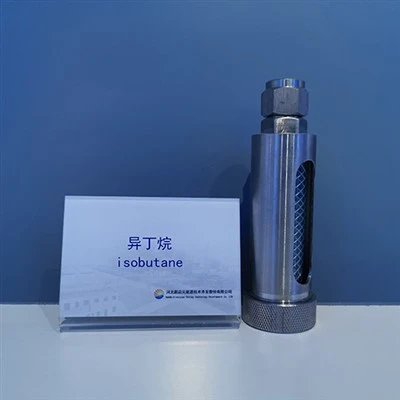
Isobutane (CAS 75 - 28 - 5)
Isobutane CAS 75 - 28 - 5 has a branched structure. Due to the branching, the reactivity might be slightly different compared to straight - chain alkanes. In radical reactions, the tertiary carbon - hydrogen bonds in isobutane are a bit weaker than primary or secondary C - H bonds. So, a radical is more likely to abstract a hydrogen atom from the tertiary carbon.
In metalation reactions, isobutane can react with strong bases like butyllithium. The reaction would follow the same general mechanism as described above, with the butyllithium abstracting a proton from the alkane to form an isobutyl lithium compound.
High Purity N - Butane (CAS 106 - 97 - 8)
High Purity N - Butane CAS 106 - 97 - 8 is a straight - chain alkane. In radical reactions, the hydrogen atoms on the secondary carbons are more likely to be abstracted compared to those on the primary carbons. This is because the resulting secondary alkyl radicals are more stable than primary alkyl radicals due to hyperconjugation.
When reacting with a strong base in a metalation reaction, n - butane can form a butyl lithium compound. The reaction would occur at one of the carbon atoms, and the choice of which carbon depends on the reaction conditions and the nature of the base.
N - Butane (CAS 106 - 97 - 8)
Another great product is N - Butane CAS 106 - 97 - 8. It has similar reactivity patterns as high - purity n - butane. However, the presence of impurities in regular n - butane might slightly affect the reaction rate or the selectivity of the reaction.
Industrial Propane (CAS 74 - 98 - 6)
Industrial Propane CAS 74 - 98 - 6 is a three - carbon alkane. In radical reactions, the secondary C - H bond in propane is more reactive than the primary C - H bonds. So, a radical is more likely to abstract a hydrogen atom from the middle carbon.
In metalation reactions with strong bases, propane can be converted into a propyl lithium compound. The reaction would involve the base abstracting a proton from one of the carbon atoms in propane.
Isobutane R600a (CAS 75 - 28 - 5)
Isobutane R600a CAS 75 - 28 - 5 is often used in refrigeration applications. But from a chemical reactivity perspective, it has the same reaction mechanisms as regular isobutane. It can participate in radical and metalation reactions with bases under the appropriate conditions.
Why Our Products Matter
Our alkane products are of high quality and purity. This is crucial when it comes to chemical reactions. Impurities can sometimes act as inhibitors or can cause side reactions, which can affect the overall yield and selectivity of the reaction.
When you're working on a project that involves reacting alkanes with bases, using our products ensures that you get consistent results. Whether you're a researcher in a lab or a manufacturer in an industrial setting, our alkanes can be a reliable choice for your chemical processes.
Let's Connect!
I hope this blog has given you a better understanding of the reaction mechanisms of alkane products with bases. If you're interested in purchasing any of our alkane products, or if you have more questions about their reactivity, don't hesitate to reach out. We're here to help you with all your alkane product needs and ensure that you have a smooth experience in your chemical endeavors.
References
- Brown, W. H., & Iverson, B. L. (2018). Organic Chemistry. Cengage Learning.
- Carey, F. A., & Sundberg, R. J. (2014). Advanced Organic Chemistry Part A: Structure and Mechanisms. Springer.